O. Kovalenko, PhD in Agricultural Sciences, Mykolaiv National Agrarian University; S. P. Polianchykov, KVADRAT Research and Production Company; A. I. Kovbel, head of Demetra+ Farm.
Leaf tissue analysis is a chemical test of plant tissue that measures its current nutrient concentrations. Healthy plants need different concentrations of essential elements depending on the crop and its growth stage. Tissue analysis, especially of leaves, is a practical tool for monitoring crop nutrition and supporting balanced growth.
The results provide an indication of plant health and of nutrient availability through roots and leaves. They also help diagnose nutrition problems. For some crops, tissue analysis can help identify a suitable harvest time. It is particularly useful in intensive crop production.
Visible symptoms of nutrient deficiency often appear only after yield potential has already been lost. Timely leaf analysis can identify an imbalance earlier and give the grower an opportunity to respond.
Using leaf analysis to improve crop nutrition involves three stages:
Both methods assess nutrients needed for plant growth, but they answer different questions. Soil testing is most useful for planning soil fertility and fertilization before sowing. Leaf analysis shows the plant's nutrient status during the growing season. It is especially valuable when drought, heat, or other conditions restrict uptake through the roots.
A soil test cannot show how effectively a crop will absorb the nutrients present. A leaf test can reveal a current deficiency, but on its own it may not identify its cause. Low soil nutrient content, unsuitable soil pH, and other limits on uptake can produce similar plant symptoms. Comparing tissue and soil results helps distinguish between these possibilities. The two methods therefore complement each other.
Leaf tissue analysis supports both routine monitoring and diagnosis of specific problems:
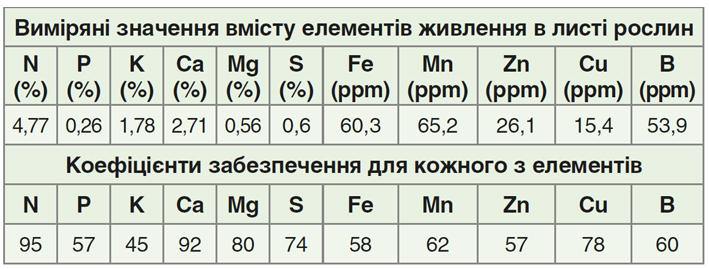
The original article uses a nutrient-status index to illustrate how results may be interpreted:
Repeated leaf sampling at critical growth stages helps track crop development and indicates when a fertilization program may need to change. This can prevent nutrition problems as weather conditions shift through drought, heavy rain, heat, or frost. The approach can be particularly valuable for intensively grown crops.
To investigate a suspected deficiency or toxicity, collect plant samples from two groups: plants that appear healthy and plants showing symptoms. Take corresponding soil samples from each area. Soil analysis adds information about fertility, pH, and plant-available nutrients. Comparing plant and soil results can help establish whether the symptoms reflect low soil supply, poor uptake under current conditions, or another cause such as pest damage.
Reliable results depend on consistent sampling. Collect leaves in the morning, preferably before midday, when there is no rain or dew. Avoid soil contamination on the leaves. Take samples from multiple locations across the field, following a diagonal or zigzag route. The leaves selected and the cutting method should match the crop and its growth stage.
A leaf analysis report has three parts: laboratory results, interpretation, and recommendations. Laboratory results give nutrient concentrations on a dry-matter basis. Interpretation compares each element with the expected range for the crop. In the method described by the original article, concentrations are converted to an index from 0 to 124, with a desirable range generally around 50–75. Recommendations then identify feeding measures needed to correct an imbalance.
A soil test may show adequate nutrient supply while a crop still experiences deficiency in the field, for example during drought or high temperatures. Leaf analysis adds direct evidence of what the plant is taking up and strengthens decisions based on soil testing.
Plant tissue analysis has long been used in agronomy. KVADRAT opened a laboratory for leaf-based crop nutrition analysis in 2014 and developed methods for identifying nutrient deficiencies and planning effective feeding programs from the results.